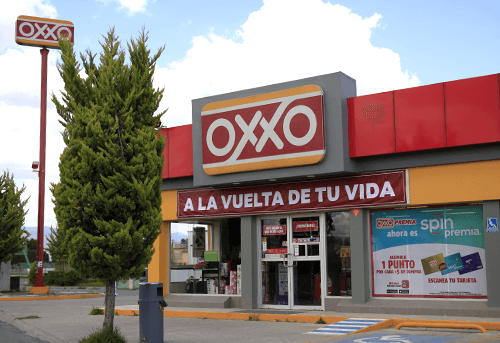
When I first arrived in Mexico I made the same mistake most foreigners make. I saw OXXO and filed it as a convenience store: water, a Coke, a coffee, aspirin if I needed it. There was one on every corner, sometimes two facing each other, and I assumed the country simply liked corner shops.
Then I started watching what people actually did inside them. They were paying electricity bills and topping up phones. Sending money to family in another state and collecting money sent back. Paying for things they had bought online, in cash, at the counter. Depositing and withdrawing. After a while my question changed. I stopped wondering why there were so many OXXOs and started wondering why so much of the country seemed to flow through one.
I have spent a long time building software, payment systems, and SaaS platforms, and eventually I realized I had been reading OXXO wrong. It is not retail. It is infrastructure. And it turns out to be one of the clearest examples I have seen of how digital transformation actually happens in the real world, as opposed to how technologists imagine it.
The story technologists tell themselves
People in tech love a disruption story. We picture the future arriving like a software release: version one, version two, then a version three that deletes everything before it. Stores become apps, cash becomes wallets, branches become websites. It is a tidy narrative, and it is almost never how a society actually changes.
Mexico is the counterexample. Over the past decade mobile banking, fintech, QR payments, and e-commerce all arrived. If the disruption story were right, OXXO should have faded. Instead it grew. More stores, more services, a bigger role in the economy. The digital revolution showed up and made the convenience store more important. That only makes sense if OXXO was never competing with digital transformation in the first place. It was enabling it.
Bridges beat endpoints
The most durable lesson I have taken from building systems is that technology rarely wins by replacing what exists overnight. It wins by connecting things. Old world to new, physical to digital, human to automated. The winners are usually the bridges, not the endpoints.
That is what OXXO became. Millions of Mexicans still live partly in cash. Plenty of people have digital services but still handle physical money every week. Plenty of businesses need a way to reach customers who will never type in a card number. OXXO sits in the middle of all of it. You can buy something online and pay for it in cash at the counter. A digital service can reach someone who has no credit card at all. A fintech can pick up a nationwide physical footprint almost overnight by plugging into the network. OXXO Pay grew into one of the country’s main bridges between cash and e-commerce, letting people finish an online purchase at a store down the street.
From a systems point of view that is the interesting part. OXXO is not replacing the old infrastructure. It is translating between infrastructures.
Mexico’s physical API
An API lets two systems talk without either one having to understand the other’s internals. That is more or less what OXXO does for the country. Cash economy on one side, digital economy on the other, and a counter in between that speaks both. Need to pay a utility bill, top up a phone, fund an online order with cash, or reach a town where your company has no branch? The answer is the same store. With more than twenty thousand locations, OXXO stopped being a chain of shops a long time ago and became a national service layer.
Seen this way, the stores are almost beside the point. The network is the product.
The best infrastructure disappears
Working infrastructure becomes invisible. Nobody wakes up grateful for the electrical grid or admires a payment rail that simply clears. You only notice these things when they fail. OXXO has reached that status. Most Mexicans do not think of it as infrastructure at all. It is just how things get done, an assumption rather than a service. That is precisely the moment a platform crosses over: when it stops being something you choose and becomes something you take for granted.
Why the digital companies keep coming back
Here is the part I find most telling. When digital-first companies enter Mexico, many of them end up needing OXXO. Not in spite of being digital. Because they are. Nubank, one of the largest digital banks in the world, leaned on the OXXO network so its customers could deposit and withdraw cash across the country, turning thousands of counters into physical touchpoints. A company built to make branches unnecessary still needed somewhere that money becomes paper and paper becomes money again.
That is not a failure of digital transformation. It is what the successful version looks like. Digital systems still need physical doors. The future is not purely digital. It is hybrid, and a lot of the value lives in the hybrid layer.
What it taught me about modernization
Outsiders tend to assume that modernizing means tearing out the old system and installing the new one. Mexico does something more interesting, and I think more durable. It layers. Cash stays. Digital payments grow on top of it. Neighborhood commerce survives. Apps expand. The physical network evolves to hold all of it together. To an engineer that looks messy. To a systems thinker it looks resilient. The places that modernize best are often not the ones that destroy what they had. They are the ones that connect it.
I came in thinking OXXO was a convenience store. I see something else now: a trust network, a payment rail, a logistics layer, and a financial on-ramp, all wearing the disguise of a place that sells Coca-Cola and chips. The future rarely arrives by replacing everything at once. It arrives when someone builds a bridge between what already exists and what comes next. In Mexico, that bridge keeps the lights on, moves the money, and still sells you a coffee on the way out.